Why source fidelity matters when AI turns documents into courses

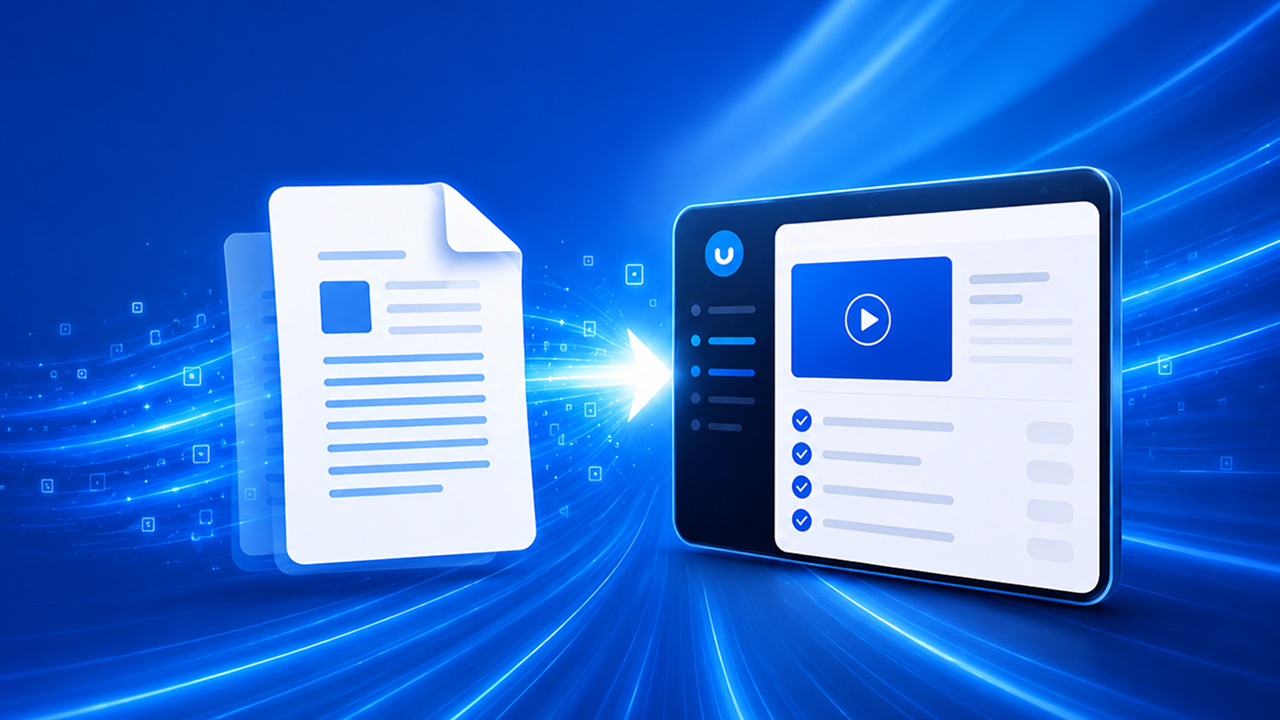
You upload a carefully written source document. The AI turns it into a course. At first glance, the output looks finished: structured, polished, and ready to review.
Then you look closer.
A procedure has been simplified. A carefully chosen phrase has become vague. A table has lost its role in the explanation. SME-approved wording has been paraphrased into something close enough, but not quite right.
This is the hidden cost of AI conversion: it doesn’t fail completely. On the surface, it almost works.
Now you have to go back to the source, check every detail, restore missing context, and decide what can be adapted, what needs explaining, and what must stay exactly as written.
That is polished distortion: AI output that looks usable while quietly weakening the meaning of the source.
JollyDeck Doc-to-Course is built to prevent that. In JollyDeck, source fidelity is treated as a conversion principle. The source stays the reference point, and AI helps turn it into structured learning without overwriting what made it valuable.
That is what we mean by true-to-source conversion: keeping meaning, structure, context and critical details aligned with the original document as it becomes a course.
Speed is no longer the hard part
AI has already changed how learning content gets made. Drafts, outlines, summaries and first-pass course structures can now be created in minutes. For many teams, the blank page is no longer the bottleneck.
But fast generation is only useful if the output can be trusted.
That is where document-to-course conversion becomes more of a challenge than it first appears. The goal is not just to produce slides, screens or questions from a source document. The goal is to preserve what the source actually means while turning it into learning.
AI-generated learning is only useful if it stays true to the source.
That includes structure, terminology, intent, context and the knowledge built into the source.
When those elements survive conversion, AI can genuinely reduce production work. When they do not, teams are left with output that looks efficient but still needs to be checked, corrected and rebuilt before it can be used.
The real gap in AI course generation is not speed. It is source fidelity.
The hard part is knowing what must stay intact
Modern AI tools are getting better at reading source material. But understanding the source is not the same as knowing what should change.
In learning conversion, some content can be shortened, some needs explaining, and some must stay exactly as written.
A procedure can be adapted into a learning step. A compliance phrase may need to remain untouched. A table may carry meaning that a summary would lose.
This is where polished distortion happens: AI changes the wrong things while making the output look usable.
At JollyDeck, we believe AI should respect the source, not overwrite it. That is why true-to-source conversion sits at the centre of Doc-to-Course.
What learning teams actually need from AI
Learning teams do not need AI to produce more content for its own sake. They need conversion they can trust enough to build on.
That means three things:
Source fidelity
The output must stay true to the source. Meaning, terminology, procedures and critical details should survive the move from document to course.
Useful structure
A useful course structure follows the logic of the material instead of flattening everything into a generic template. The starting point needs to reduce restructuring work, not create another editing project.
Author control
AI can make useful suggestions and help authors adapt content faster. But the author still needs control over what to simplify, what to explain, and what must stay exactly as written.
When those pieces are missing, AI does not save time. It hides the work in review, repair and rework. That is the hidden toll of Polished Distortion.
Useful AI conversion does not replace the author. It keeps the output aligned with the source.
JollyDeck Doc-to-Course: true-to-source conversion in practice
JollyDeck Doc-to-Course is not designed to act like a generic AI course generator. It is built to convert existing materials into structured learning without losing the knowledge and context inside the source.
It is built for people who care about their training materials: people who have done the work, refined the details, and do not want that effort lost in conversion.
AI proposes. The author decides.
The source stays the reference point, and the author stays in control of how it becomes learning.
That changes how the conversion works:
| Generic conversion risk | True-to-source conversion response |
| Critical wording gets paraphrased | Exact wording, values, quotes and fixed text can stay intact |
| Source structure gets flattened | The course follows the logic of the original material |
| Tables and visuals lose meaning | Important source elements are carried through where they support learning |
| AI makes too many decisions too early | Authors review and adjust the outline before generation |
| Output looks finished before it is trusted | Everything remains editable before publishing |
The point is not to lock the course to the source word for word. It is to keep the source as the reference point while giving the author control over how it becomes learning.
What this means for learning teams
When conversion keeps the source intact, the workflow changes. Teams spend less time checking whether AI has quietly changed the meaning, and more time improving the learning experience.
Complex materials become easier to convert
Technical, procedural and compliance-heavy documents can move into course format without every sentence becoming a risk to inspect.
Review cycles become more focused
SMEs do not have to hunt for distortions, missing context or rewritten details. They can spend more time validating quality and less time repairing the output.
Learning design gets more attention
When the source structure, terminology and critical details survive conversion, authors can focus on sequencing, clarity, practice and learner experience.
Output becomes more consistent
Teams can apply the same conversion principles across documents, instead of relying on each author to manually catch what the AI changed.
The result is not just faster production. It is less hidden repair work, more reliable output, and more time spent on the parts of learning creation that actually need human judgement.
Turn a real document into structured learning
Source fidelity should be the standard for AI-generated learning. The best way to judge it is with a document your team already uses.
Choose a policy, procedure, onboarding guide, technical manual or SME-approved training document.
Upload it to JollyDeck Doc-to-Course and see how faithfully the source becomes structured learning.